

Shaolin Kung Fu and Modern Wushu: Two Paths of the Same Martial Spirit
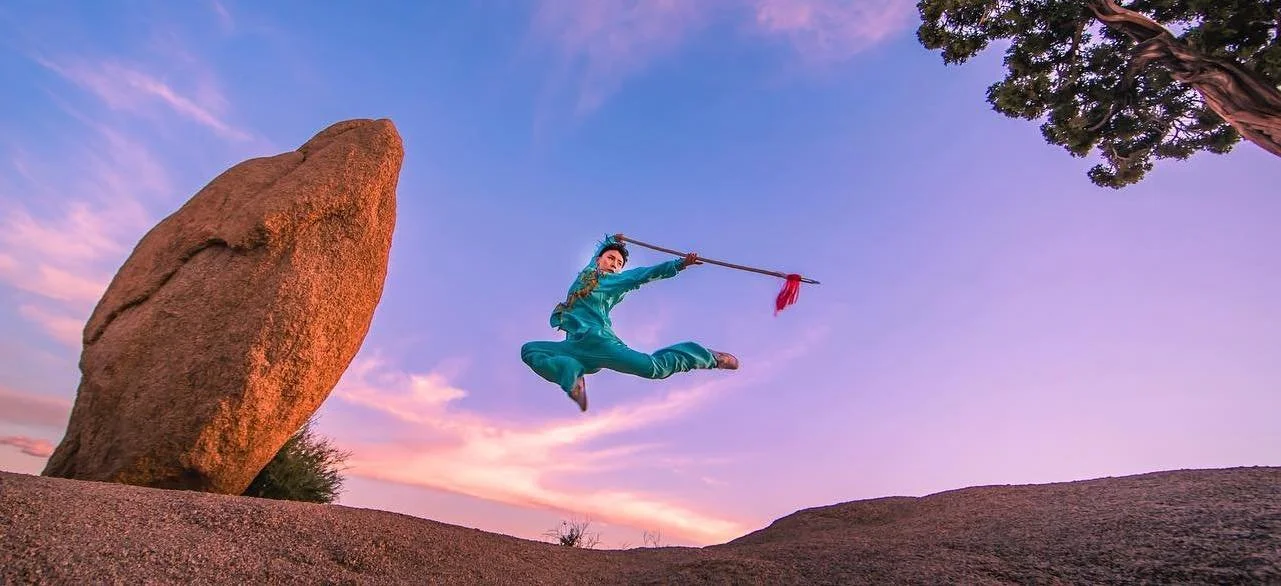
Xueyuan yangchen demonstrates spear
Many people outside China have asked me a deceptively simple question:
“Is Shaolin Kung Fu the same as modern Wushu?”
I usually smile before answering.
Because the truth is not a quick yes-or-no.
Shaolin Kung Fu and modern competitive Wushu come from the same vast cultural landscape of Chinese martial arts, but they were shaped by very different histories, philosophies, training systems, and aesthetic ideals.
If Chinese martial arts were a great mountain, Shaolin Kung Fu would be an ancient temple hidden among the cliffs, where the sound of a wooden staff echoes against stone walls. Modern Wushu would be a bright international stage, where speed, precision, beauty, and athletic excellence are brought into full view.
One carries the silence of deep roots.
The other carries the brilliance of movement in flight.
Both are powerful.
Both are beautiful.
But they are not the same.
One Was Born in a Temple. One Was Shaped for the World Stage.
Shaolin Kung Fu is inseparable from the Shaolin Temple, one of the most recognizable symbols of Chinese martial culture.
When people imagine Shaolin, they often picture ancient temple walls, monks in simple robes, early morning training, wooden staffs, steady breathing, and the quiet rhythm of footsteps on stone floors. This image is not merely romantic; it reflects the historical environment in which Shaolin Kung Fu developed.
For centuries, Shaolin martial arts grew within Buddhist temple culture. Its practice was never only about combat. It was also connected to Zen cultivation, discipline, self-restraint, moral training, and the integration of body and mind.
Traditionally, Shaolin Kung Fu was practiced mainly by monks within the temple system. Because of historical religious customs, women were generally excluded from monastic training in earlier periods. Today, however, Shaolin Kung Fu has opened far beyond the temple walls. Men, women, children, athletes, artists, health enthusiasts, and martial arts lovers from around the world can now study Shaolin martial arts through professional masters and training institutions.
Modern competitive Wushu followed a different historical path.
It developed much later as a standardized sport system. After the founding of modern China, many traditional martial arts movements were organized, refined, and adapted for modern competition. This allowed Chinese martial arts to be taught, judged, performed, and promoted internationally with clearer rules and shared technical standards.
If Shaolin Kung Fu is an ancient tree with deep roots, modern Wushu is a carefully built bridge — one that carries Chinese martial arts across cultures, languages, and international arenas.
One Looks Inward. One Reaches Outward.
The biggest difference between Shaolin Kung Fu and modern Wushu is not only in the movements. It is in the direction of the spirit.
Shaolin Kung Fu looks inward.
In traditional Shaolin training, the practitioner is not only developing strength, speed, or fighting ability. They are also training attention, patience, breathing, emotional control, awareness, and inner steadiness.
A punch is not merely a punch.
A stance is not merely a stance.
A moment of stillness may be as meaningful as a powerful strike.
This is why Shaolin Kung Fu is often associated with Zen practice. It teaches the practitioner to return to the body, quiet the mind, and refine the self through repeated discipline.
Modern Wushu reaches outward.
It asks the body to express martial arts with clarity, beauty, rhythm, athleticism, and stage presence. It emphasizes speed, flexibility, precision, jumping ability, coordination, confidence, and technical difficulty.
In modern Wushu, the athlete must fully open the body. The jump must be high. The landing must be clean. The rhythm must be sharp. The expression must reach the audience.
Its spirit is close to modern sport: train hard, challenge limits, refine technique, and present excellence under clear standards.
Shaolin Kung Fu is like meditation with power.
Modern Wushu is like athletic poetry in motion.
One teaches us how to return to the center.
The other teaches us how to expand into space.
One Is Rooted Like the Earth. One Moves Like the Wind.
If you watch Shaolin Kung Fu and modern Wushu side by side, the difference becomes visible almost immediately.
Shaolin Kung Fu often feels compact, grounded, direct, and powerful. Its movements tend to stay close to the body and are often connected to traditional attack-and-defense principles. There is a strong sense of stability, intention, and explosive force.
It gives the feeling:
“I am rooted. I am ready. I do not move without purpose.”
Modern competitive Wushu is usually more extended, fluid, expressive, and visually dramatic. It often uses large ranges of motion, beautiful body lines, fast transitions, high jumps, spins, aerial skills, and rhythmic choreography.
It gives the feeling:
“I am moving through space. I am showing the full beauty of the body.”
In this way, modern Wushu shares something with gymnastics, dance, and figure skating. It combines athletic difficulty with artistic presentation.
Shaolin Kung Fu feels closer to the earth.
Modern Wushu feels closer to the air.
But this does not mean one is superior to the other. They simply speak different movement languages.
One speaks in roots.
The other speaks in wings.
The Training Systems Tell Two Different Stories.
Shaolin Kung Fu contains a vast traditional system developed over many generations.
Its forms, methods, and weapons reflect centuries of accumulated practice. Many Shaolin styles are inspired by animals and natural forces — tiger, crane, snake, monkey, eagle, mantis, and others. These names are not merely decorative. They show how traditional martial artists observed nature, power, balance, instinct, rhythm, and survival, then transformed those observations into physical practice.
Shaolin weapons are also rich and diverse. Staffs, broadswords, spears, straight swords, and many traditional weapons appear across different systems and lineages.
Modern competitive Wushu is more streamlined and standardized.
In international competition, the main routines usually include events such as Changquan, Nanquan, Taijiquan, and standard weapons, including straight sword, broadsword, spear, and staff.
This standardization has an important purpose. It allows athletes from different countries and backgrounds to train under shared rules. It makes competition clearer, judging more consistent, and international communication more effective.
So Shaolin Kung Fu is like entering an ancient library filled with old scrolls, hidden rooms, and many generations of wisdom.
Modern Wushu is like entering a professional sports arena where rules, scoring, timing, and presentation allow the art to be understood by the world.
Both systems are valuable.
One preserves depth.
The other creates visibility.
Even the Clothing Reveals the Philosophy.
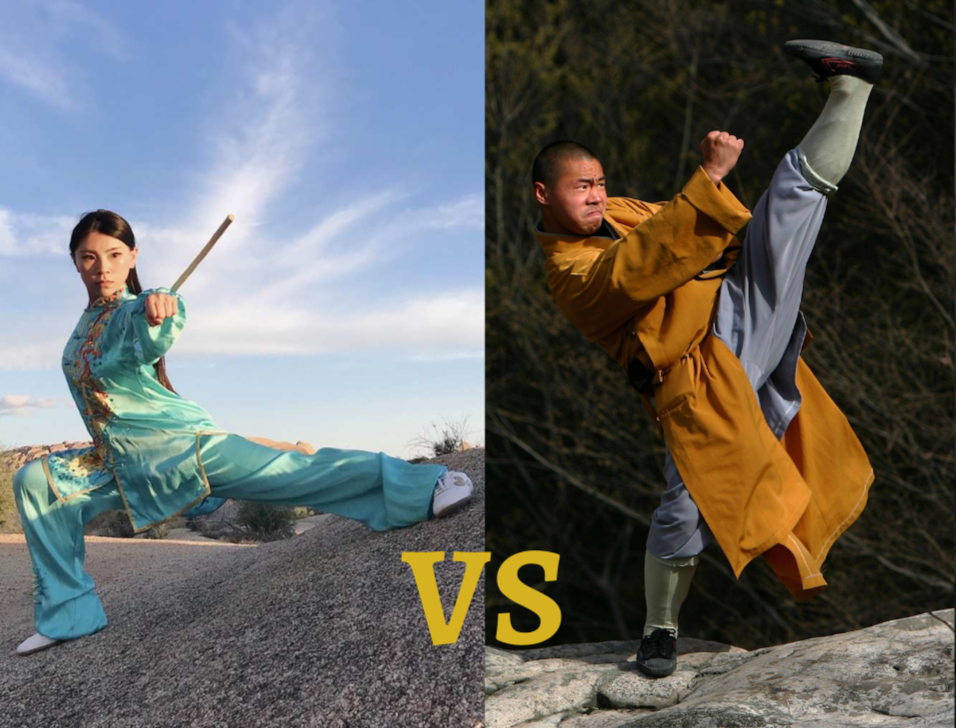
Xueyuan Yangchen and Yanqing Shi
Clothing may seem like a small detail, but in martial arts, even clothing tells a story.
Traditional Shaolin clothing is usually simple, practical, and modest. The colors are often calm — gray, brown, yellow, or other earthy tones. The design reflects temple life, discipline, function, and restraint.
It does not try to attract attention.
It says:
“I came here to train.”
Modern Wushu uniforms are different. They are often lighter, brighter, more fluid, and more performance-oriented. Many use silk-like fabrics, embroidery, gradients, or bold colors that highlight speed, extension, rhythm, and elegance under stage lights.
They say:
“I came here to perform.”
Neither is more authentic simply because of appearance.
Each belongs to its own world.
Shaolin clothing reflects simplicity and discipline.
Modern Wushu clothing reflects movement and visual expression.
Both are honest when they serve the practice's purpose.
So, Which One Should You Learn?
This is the question people truly want to ask.
And my answer is simple:
It depends on what you are looking for.
If you are drawn to tradition, Zen culture, inner discipline, grounded power, historical depth, and the feeling of ancient Chinese martial arts, Shaolin Kung Fu may speak to you.
If you love athletic movement, beautiful lines, speed, flexibility, performance, competition, and international sports culture, modern Wushu may excite you more.
Some people love the quiet strength of Shaolin.
Some people love the bright energy of Wushu.
Some people practice both — and that is also a beautiful path.
Chinese martial arts culture is not a single road.
It is a mountain with many paths.
Some paths are quiet.
Some are spectacular.
Some are spiritual.
Some are athletic.
Some are for health.
Some are for performance.
Some are for self-discipline.
Some are for cultural inheritance.
The important question is not:
Which one is better?
The better question is:
Which path helps you move, learn, and grow?
Final Thoughts: A Culture Broad Enough to Hold Both
To me, Shaolin Kung Fu and modern competitive Wushu are not opposites.
They are two different expressions of Chinese martial arts culture.
Shaolin Kung Fu carries the depth of tradition, Zen philosophy, discipline, and inner cultivation.
Modern Wushu carries the beauty of modernization, athletic excellence, international exchange, and performance art.
One is an ancient temple hidden in the mountains.
The other is a brilliant stage under the lights.
One teaches stillness inside strength.
The other reveals beauty through motion.
Both carry discipline.
Both carry courage.
Both carry the spirit of Chinese movement culture.
Perhaps the most beautiful thing about Chinese martial arts is not that it gives us only one answer.
It gives us many doors.
And behind each door is a different way to understand the body, the mind, and the long journey of becoming stronger, wiser, and more fully alive.
